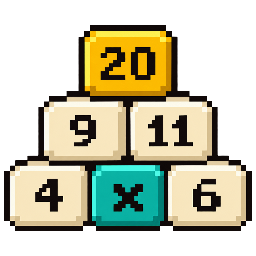
Number Towers: Unknowns and Patterns
Use variables to build expressions, solve taller towers, combine known totals, and prove patterns. Finish with selected UKMT competition challenges.
Junior Olympiad · 0 of 13 solved · Difficulty 5/10
The top is now 21. In letters that is a + 2b + c, so the middle brick contributes twice.
A letter lets you work with a hidden brick before you know its value. Use that idea to build expressions, solve equations, and find a required total even when the whole tower cannot be recovered.
Be comfortable adding and subtracting through a tower, and solving a simple equation such as . If you are new to towers, start with Number Towers: Build and Work Backwards.
Let an unknown travel through the tower
If the bottom row of a three-level tower is , , , its middle row is , . The top is . The centre has coefficient because it appears in both middle bricks.
The bottom row is , , and the top is . Add adjacent expressions: the middle row is , . Hence , so and . Checking gives bottom , , , middle , , and top .
A three-level tower has bottom row , , and top . Find .
Try numbers and letters in the shared number tower sandbox. Compare the expressions with the sums you would write by hand.
Find only what is asked
Name the unknowns, build the expressions you need, then substitute known sums or subtract equations to remove unwanted terms. A problem can determine one brick or one sum without determining every bottom number.
The top is and the bottom corners add to . Write the bottom as , , . Then and . Substitute to get , so .
The corners might be , or , . Their individual values are not determined, and we do not need them.
Do not insist on solving for every letter. First identify the exact brick or combination the question asks for. The data may determine that combination uniquely.
Taller towers and repeated copies
For four levels, bottom , , , gives top . For five levels, bottom , , , , gives top . Build the intervening rows to check these formulas. The coefficients are rows of Pascal's triangle; memorising them is optional.
0 of 3 steps revealed
In a four-level tower, why should the two largest available bottom numbers go in the middle positions if you want to maximise the top? Explain using the coefficients, then test an arrangement.
Patterns that always hold
Letters also let you prove a statement for every tower. In three levels, the parity of depends only on because is even when the bricks are integers. If both corners are odd, the top is even.
For IMC 2022 Q14, give the three equal bricks in the three-brick row the same name, . The two above are and , so the top is . Since is an integer, the top must be a multiple of . The source paper is Intermediate, but this short argument is suitable Junior practice.
A competition finish
Problems 1–4 practise equations and combining sums. Problems 5–8 develop four- and five-level formulas and optimisation. Problems 9–10 apply algebra to the sealed and alien pyramids. Problems 11–12 ask for parity and divisibility arguments. The final challenge is JMC 2022 Q25.
You need not reconstruct every brick. A complete argument should also check that the required centre value can occur in a tower satisfying the given conditions.
Use the same letter for the same unknown and add expressions up the tower. Coefficients count repeated contributions. Substitute known totals and subtract equations to isolate the quantity you need. Check any numerical answer in the original conditions, and use integer assumptions when making parity or divisibility claims.
Competition practice reuses IMC 2022 Q14 and JMC 2022 Q25, both © UK Mathematics Trust. See the JMC 2022 official solutions for the final problem. The sealed and alien pyramid challenges retain their attribution to Henri Picciotto's TED-Ed riddle.